
CCWX 2025 Event
November 27, 2025 | 5:00 – 7:00 PM MST | Hybrid (Calgary + Virtual)
A Two-Chapter Panel Event at the Foothills Medical Centre
Climate change is no longer a distant environmental issue, it is a brain and mental health issue, unfolding right now. From smoke-filled skies to heat waves and system strain, climate impacts are beginning to shape neurological risk, stress, and lived experience across the lifespan. The costs are not distributed evenly.
This event brings together researchers, clinicians, community leaders, artists, and trainees to ask one urgent question:
What does it look like to protect brain health in a heating world and how do we ensure that equity and justice are not afterthoughts, but starting points?
We explore this through two connected chapters: part one clarifies the problem; part two points to action, justice, and possibility.
🔍 One Goal, Two Chapters
Overarching Objective
To explore how climate change is affecting brain and mental health, especially for equity-denied communities, and what actions different sectors can take right now.
🧠 Panel 1 — “Understanding the Problem”
Focus: What’s happening? Who’s at risk? What does the science, clinical reality, and lived experience tell us?
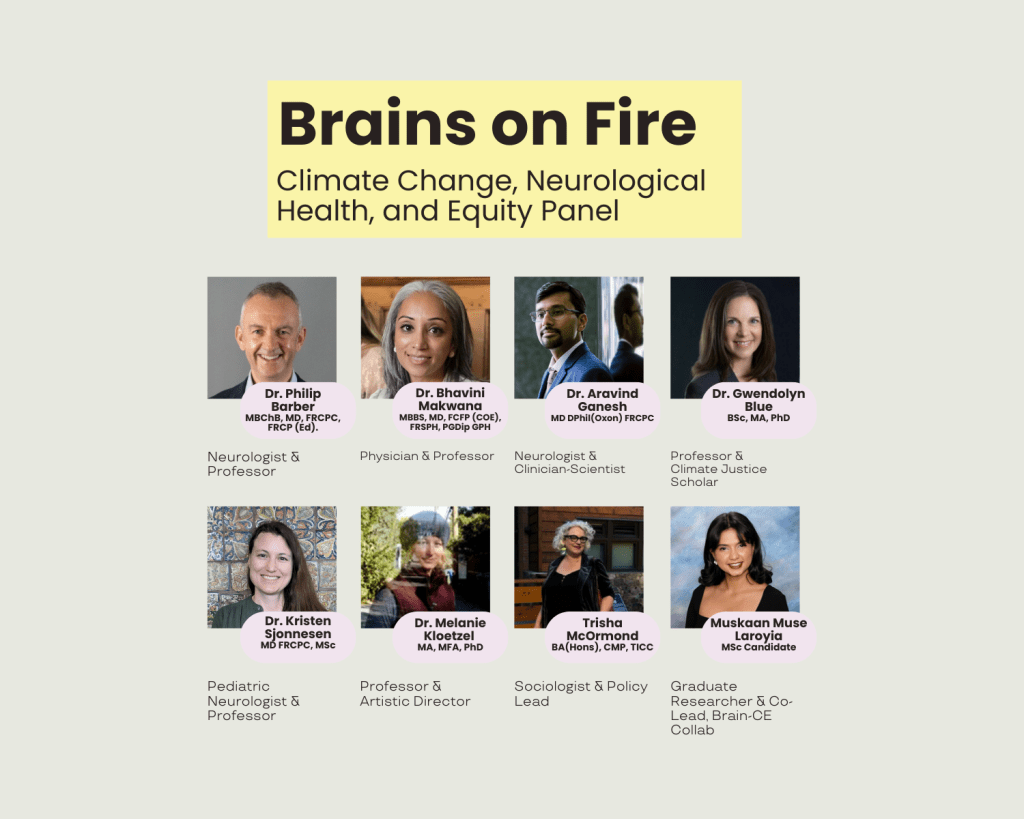
Panelists:
- Dr. Bhavini Gohel (Makwana)
- Dr. Philip Barber
- Dr. Kristen Sjonnesen
- Dr. Melanie Kloetzel
Panel 1 builds urgency and clarity. We hear what neurologists, physicians, pediatric experts, and artists are already seeing across clinics, communities, and bodies — and who is being left behind.
🔁 Transition
Panel 1 asks: What’s actually happening?
Panel 2 asks: Now what? How do we respond – fairly, creatively, and urgently?
🔧 Panel 2 — “From Evidence to Justice-Centred Action”
Focus: How do we design responses – in systems, communities, and policy – that actually shift outcomes and centre justice from the outset, not as an afterthought?
Panelists:
- Dr. Aravind Ganesh
- Dr. Gwendolyn Blue
- Muse Laroyia
- Trisha McOrmond
Panel 2 brings in a justice lens, explores real levers for change, and highlights pathways already emerging across health systems, public engagement, disaster risk, youth leadership, and policy.
🕑 Event Structure & Timing
| Time | What’s Happening |
|---|---|
| 5:00 PM | Doors open |
| 5:15 PM | Chapter 1 – Understanding the Problem (30 mins moderated + 15 mins audience Q&A) |
| 6:00 PM | Transition + social break (15 mins) |
| 6:15 PM | Chapter 2 – From Evidence to Justice-Centred Action (30 mins moderated + 15 mins audience Q&A) |
| 7:00 PM | Thank-yous & optional mingling |
🎙️ Meet the Panelists
Dr. Philip Barber
Stroke Neurologist & Professor of Neurology & Radiology
Dr. Barber is a stroke neurologist and Professor at the University of Calgary, studying how vascular risk factors and silent brain injuries contribute to stroke and dementia. His work connects climate-driven stressors, like heat and air pollution, to vascular brain health and prevention strategies across the lifespan.
Dr. Bhavini Gohel (Makwana)
Hospitalist, Care of the Elderly Physician & Section Chief of Medical Inpatients, AHS
Dr. Gohel works at the intersection of acute care, aging, health policy, and climate adaptation. Within AHS, she leads efforts to advance low-carbon, resilient health systems, especially for older adults juggling medical, social, and economic vulnerability during climate stress.
Dr. Kristen Sjonnesen
Pediatric Neurologist & Clinical Assistant Professor
Dr. Sjonnesen’s work focuses on children with neurological and developmental conditions. She offers a critical perspective on how early-life exposures, social disruptions, and environmental stressors, including climate change, may shape brain health across a lifetime.
Dr. Melanie Kloetzel
Professor of Dance & Artistic Director (TRAction & kloetzel&co.)
Dr. Kloetzel is a choreographer and scholar using site-specific performance and public art to surface climate crisis in embodied ways. Her work invites us to ask: how do people feel climate change in their bodies, attention, memory, and could art act as a nervous-system intervention?
Dr. Aravind Ganesh
Stroke Neurologist & Clinician-Scientist
Dr. Ganesh works at the interface of data, policy, equity, and stroke prevention. His research spans decision science, epidemiology, and health systems, with growing focus on how we design clinical guidelines and triage systems for a heating world without deepening inequities.
Dr. Gwendolyn Blue
Associate Professor of Geography & Climate Justice Scholar
Dr. Blue studies climate governance, public engagement, and energy justice across scales, from local initiatives to global COP negotiations. Her work examines whose expertise is recognized, who gets heard, and how public dialogue can support more just responses to environmental risk.
Muskaan Muse Laroyia
MSc Neuroscience Candidate & Co-Founder, Brain-CE Collab
Muse bridges hippocampal circuit research with climate justice and social innovation. Their work builds youth-driven and community-led initiatives that translate evidence into action, including national efforts to mobilize students, trainees, and lived-experience experts.
Trisha McOrmond
Policy Lead, Hazardscape Management & Founder, Magpie Inc.
Trisha works where disaster risk, work, policy, and everyday life meet. With experience in early-years and social policy, she explores what trauma-informed, climate-ready systems and workplaces could look like, especially for communities most at risk before, during, and after climate shocks.
🧭 Guiding Questions
Across both panels, speakers will explore:
- What patterns are we already seeing in clinics, communities, policy, culture?
- Who is most at risk and why?
- What futures are ahead if nothing changes?
- How can systems prevent neurological harm in a heating world?
- What does justice-centred action look like, from data to art?
- What gives us hope right now?
A selection of backup questions will also allow for flexibility and genuine conversation, this is not a presentation, but a shared space to think, challenge, and imagine together.
💡 Why This Matters
Climate change is shaping neurological and mental health today — often silently, unevenly, and across generations. This event asks not only how we protect brains and bodies, but how we rethink who participates, who benefits, and how we design systems that don’t leave communities behind.
It’s not just about resilience. It’s about justice.
🧩 Presented by
Brain Climate Equity Collaborative (Brain-CE Collab)
In partnership with Canada Climate Week (CCWX).

 Brain Climate & Equity Collaborative